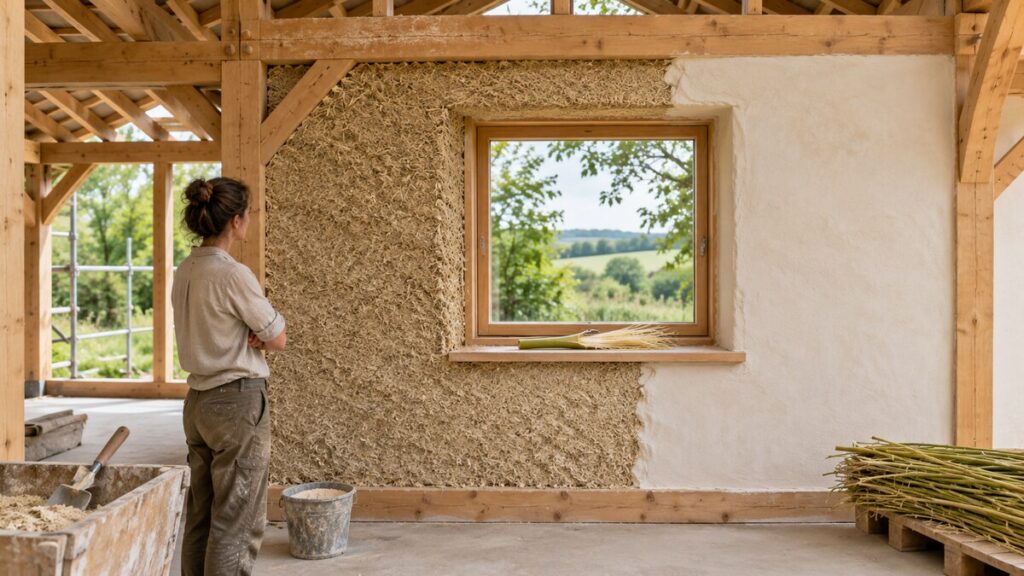
A hemp plant takes carbon dioxide from the air as it grows. Part of its stem may later spend decades inside a wall. Between those two observations lies a surprisingly difficult accounting question. If growing, processing, transporting and building with the material also produce emissions, where should the calculation begin and end? Change the endpoint and the same wall can appear to have a different climate history.
Start with a square meter of something useful
Weighing two bags of building material is simple. Comparing what they accomplish is harder. A kilogram of a light insulating material and a kilogram of dense masonry do different jobs. A fairer question might concern a square meter of finished wall with a stated thermal performance over a stated service life. That comparison forces the investigator to include the required thickness, the binder and any other components needed to deliver the specified function.
In a study of hemp concrete walls with different thicknesses and coatings, the wall design itself was a variable in the environmental assessment. A thicker wall contains more plant material and therefore records more carbon in the product. It also requires more material to be processed and delivered. Looking at only one side of that change can make almost any increase in thickness sound beneficial. A life-cycle energy and carbon analysis of hemp-lime materials illustrates how choices about binder and raw-material sourcing enter the same account.
Two kinds of carbon enter the ledger
Carbon incorporated in the hemp during growth is commonly described as biogenic. The mineral binder has a separate production history, including energy use and, depending on its composition, emissions from chemical reactions. Some lime-based materials also take up carbon dioxide as they carbonate. Those flows occur at different times and arise from different physical processes. They deserve separate entries before anyone adds them together.
One useful check is to ask what physical object contains each claimed store of carbon. If carbon in the harvested plant has already been counted as stored within the wall, carrying that same amount forward another year does not constitute a second removal. It is still there, which may be valuable, but it has not entered the wall twice. Carbon accounting becomes easier to follow when every credit has a recognizable physical counterpart.
The factory gate is a real boundary with an imaginary wall around it
A United States assessment of hempcrete explicitly uses a cradle-to-gate boundary. It asks about impacts from early inputs through production. Such a calculation is useful for comparing supply decisions at that stage. It cannot tell the whole story of a building that remains in service, is altered and eventually comes down.
Another study of hemp-lime wall construction in Serbia considers transport, waste and the possible release of biogenic carbon at the end of life. Move a bulky ingredient farther and its transport entry changes. Change what happens during demolition and the assumed fate of the plant carbon changes. Neither adjustment requires any disagreement about how much hemp went into the wall in the first place.
The date on a climate claim
Suppose a wall contains some carbon on the day the builders leave. Fifty years later, it may still be in service. Later still, parts could be reused, disposed of or allowed to decompose. A statement about storage on completion, a prediction about storage over fifty years and a claim about permanent removal are three propositions with different evidence requirements.
The shortest sensible answer to the question in the title is therefore a set of conditions. Identify the wall being compared, say which stages are counted, specify the binder and transport assumptions, and give the stored carbon an explicit fate at the end of the calculation. With those details, a negative number becomes an intelligible result for a particular design. Without them, even a perfectly accurate measurement of the carbon inside a hemp stalk cannot tell us whether building that wall reduced emissions overall.