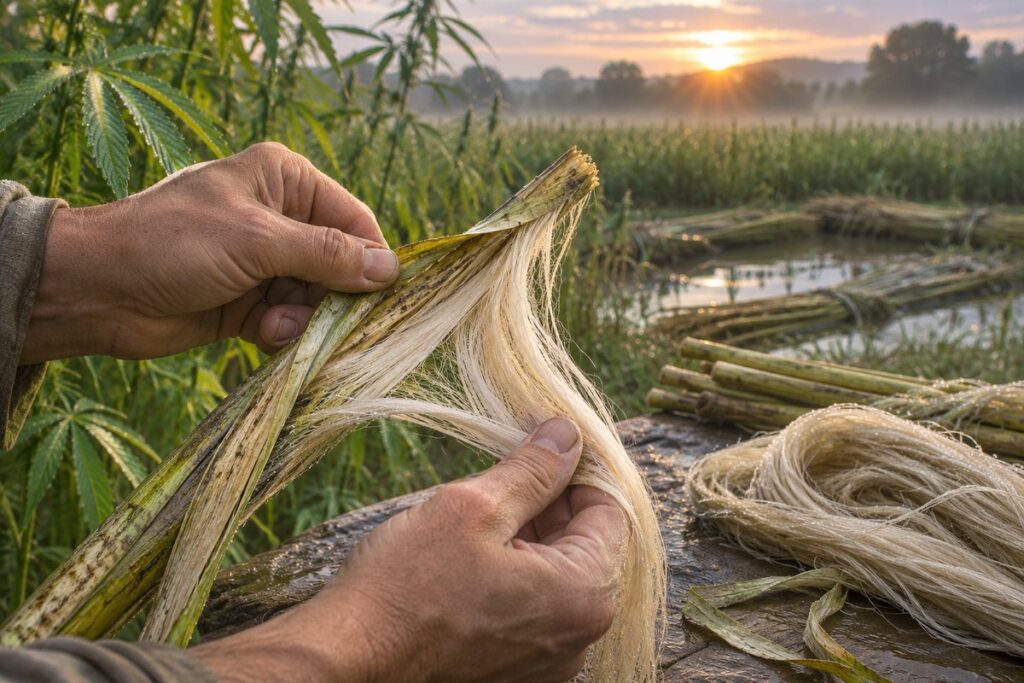
A cut hemp stalk still has quite a bit of engineering holding it together. The long fibers wanted for cloth lie in bundles toward the outside of the stem. They have to come away from neighboring tissues and the woody interior while remaining strong enough to be useful. When stalks are laid in the field for retting, some of the separation happens before a machine ever touches them.
Dew and rain wet the stems. Between wettings the surface can dry again. Fungi and bacteria work on the material during these intervals, and the stalk that comes off the field can behave very differently from the stalk that went on. Identifying the organisms on its surface sounds like a good way to find out who did the work. That turns out to be only the first of several measurements a curious textile scientist would want.
Where the stem comes apart
The useful fibers contain cellulose, which gives them tensile strength. Pectins help bind cells and tissues together. Enzymes that act on pectins can loosen these connections. For someone interested in a spinnable fiber, the location and extent of the change matter as much as the amount of material lost. A stalk can be easier to pull apart and still yield fibers of disappointing strength.
A review of field retting brings together research on these chemical, microbial and mechanical changes. Its subject is a community living on a cut stem, with all the variability that a patch of ground and a week of weather can introduce. The same number of days in two fields need not represent the same amount of biological activity.
Taking attendance on a piece of straw
In one study of hemp-retting microbes, investigators examined six samples that differed in ground type, harvest date or time spent retting. They extracted DNA and used bacterial and fungal genetic markers to characterize the communities. Some of the same organisms occurred in different samples, but their proportions varied. A list of names alone would have missed that change.
The method poses a small puzzle. Suppose bacterial sequences make up a smaller fraction of a later sample. Have the bacteria become less numerous? Possibly. Or a fungal population might have grown while bacterial abundance held steady. Even within a bacterial survey, one group can take a smaller share simply because another has expanded. Measurements of marker abundance and of the proportions represented by particular sequences give complementary views of the stem.
DNA also records presence more readily than activity. Finding a sequence can implicate an organism worth studying. It cannot establish that this particular organism produced the enzyme that loosened a particular bundle. For that question it helps to put another measurement beside the microbial census.
Listen to the chemistry as well
An experiment with a different setting illustrates the point. Researchers studying water retting after field pretreatment measured pectin-degrading enzyme activity alongside changes in microbial populations. Some stems had already spent time retting in the field before entering the water. That earlier history helped shape what happened next. The conditions in a tank differ from those on the ground, but the pairing of measurements shows how a proposed mechanism can be examined.
A comparison of hemp harvested at three growth stages found that the pace of change depended partly on the starting condition of the fiber. For a field comparison, imagine sampling several stems on each visit, recording the weather, testing how readily bundles separate, and measuring the strength of the resulting fibers. An increase in pectin-degrading activity just as separation becomes easier would make a more persuasive account than two photographs of darker straw. If strength falls later, that extra observation changes the practical meaning of “more retted.”
The finished thread gives little away about the succession of organisms that occupied the stalk. Yet its ability to survive being drawn and twisted depends partly on where that microscopic work stopped. A useful account of retting has to follow both histories, the one written in microbial DNA and the one a textile worker can feel when a fiber bundle comes free.