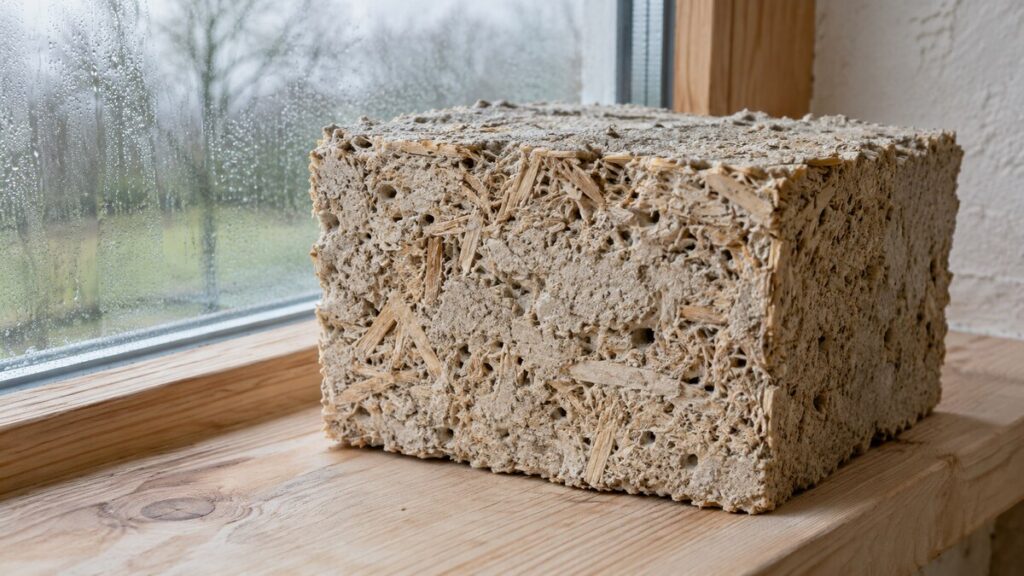
A shower sends water into a bathroom wall in at least two quite different ways. Steam raises the humidity of the air beside the wall. A splash puts liquid directly onto the surface. A porous building material can behave one way in the first experiment and quite differently in the second. That distinction matters for hemp-lime, the lightweight mixture made with the woody core of hemp stems and a mineral binder.
A wall full of small spaces
Cut through a sample of hemp-lime and you can see plant particles held in a mineral matrix. The voids within and between those particles help make the material light. They also offer routes through which moisture may move. Water vapor can travel through connected spaces in response to a difference in vapor pressure. Liquid can be drawn along small pores by capillary forces. Calling a wall “breathable” leaves it unclear which of those journeys someone has in mind.
In laboratory work on hemp-lime concretes, Rachel Walker and Sara Pavía investigated how changing the binder affected moisture transport and thermal properties. Some binder changes reduced capillary absorption. The investigators did not find a significant binder effect on vapor permeability in their comparisons. That combination is perfectly plausible in a material with several scales of pore space. The routes most important to one process need not be the routes most affected in the other.
A wet edge and a humid room
Picture two pieces cut from the same block. Stand one in a shallow tray of water and record the mass it gains as the wet front rises. Seal the edges of the other and maintain different humidities on its two faces. In the first arrangement a liquid supply touches the specimen. In the second the specimen separates two air spaces. Both measurements involve water and a scale, but the physical questions diverge almost immediately.
There is a third question a homeowner may actually care about. How much will room humidity rise during a short burst of cooking or showering? A material may temporarily take up some moisture from the air and release it as conditions change. To translate that behavior into a room-level prediction, you would need the exposed surface area, its finish, the room volume and the ventilation rate. A laboratory permeability value supplies only part of that account.
Heat follows its own route
The same porous structure also affects heat transfer. In a thermal test, investigators measure how much energy flows through a specimen under a known temperature difference. A material that conducts heat slowly can provide useful insulation at sufficient thickness. The density and moisture condition of the specimen matter to the interpretation. Comparing two published values is much easier when both reports explain what they tested and how dry it was.
A review of hemp-based materials in concrete surveys a broader range of formulations. The word hemp can refer to different plant fractions and different roles in a composite. A lightweight hemp-lime infill and a dense material containing a small amount of plant fiber need not behave alike. The name on the sack is a poor substitute for a description of the wall.
Following a drop through the finished building
A finished wall introduces features that a small specimen lacks. A section behind a cupboard, for example, exchanges moisture with indoor air under different conditions from an exposed section beside an open doorway. Coatings cover the faces. Joints interrupt the material. Rain reaches some elevations more often than others. Even the question of environmental benefit depends on the design, as a life-cycle study examining wall thickness and coating illustrates.
So when someone asks whether a hemp-lime wall handles moisture well, picture where the water is coming from. A humid afternoon, a splash and a persistent leak present different problems. Identifying the route turns a vague promise about breathing walls into an answer that can actually be tested.